
Jan. 29, 2024 - Pastor Brian Hamer
We have thought of thy lovingkindness, O God, in the midst of thy temple.
– Psalm 48:9 (Introit for Candlemas)
– Psalm 48:9 (Introit for Candlemas)
I am categorizing this column as part of my occasional “Cantatas Over Coffee” series, but it actually does triple duty as “Cantatas Over Coffee,” “Anniversaries in Sacred Music,” and “Hymns of the Reformation.” In addition to being a wonderful cantata, it was written and performed 300 years ago for Bach’s first Candlemas in Leipzig. And the work incorporates a stanza from Martin Luther’s Nunc Dimittis hymn, “In Peace and Joy I Now Depart,” which is 500 years old this year. Please join me to explore briefly all three facets of Candlemas under the theme, “We have thought of Thy lovingkindness, O God, in the midst of thy temple.”
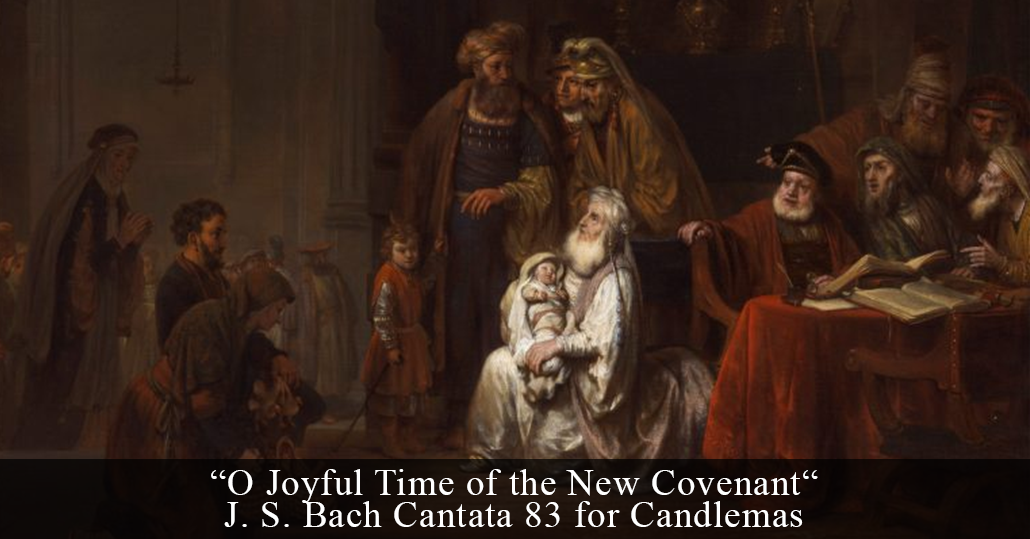
Candlemas is a principal feast of Christ in the church year, taking precedent over any Sunday that might fall on the same day. The custom of lighting candles for Christ, the Light of the world, dates at least back to Egeria, a fourth-century pilgrim whose famed travel diary documented the celebration in Jerusalem. The title “Candlemas” appears to be a later addition to an older title, “The Meeting,” which indicated the fulfillment of the Old Testament reading, Malachi 3:1-4, “The Lord, whom ye seek, will suddenly come to His temple” (v. 1). The gospel lesson for the day, St. Luke 2:22-32, which includes the presentation of Jesus in the Temple and Simeon’s canticle, the Nunc Dimittis.
The text of Cantata 83 (the number is neither liturgical nor chronological) is by an anonymous librettist and incorporates images and echoes of the appointed liturgical texts of the day, along with a few quotes from Simeon’s canticle and one stanza of a Luther hymn. As you survey the English translation below, you will see that it begins with the transition from the Old Covenant to the New Testament, as befits the Gospel for the day. As with any good sermon, however, the poet eventually places the good news of Christ into the ears and hearts of the modern hearer, especially when and if the congregation joins in the familiar hymn stanza in movement 5.
The scoring of the cantata is for alto, tenor, and bass soloists, a four-part choir for the final movement, and a small orchestra of strings, woodwinds, two horns, and continuo. Since this is a cantata for solo voices, regular readers of “Lifted Voice” will immediately notice that there is no opening chorus, leaving most of the work to the three soloists, with the addition of the soprano line (sung by the boys of St. Thomas, perhaps?) for the final chorale. The transparent textures and individual vocal lines paint a vivid and expressive musical picture as you journey from the old temple to the new and greater Temple, Christ Himself, who is present for you in the new Jerusalem.
So grab a cup of coffee, follow the translation and commentary below, and behold the One who has suddenly come to His temple.
Candlemas is a principal feast of Christ in the church year, taking precedent over any Sunday that might fall on the same day. The custom of lighting candles for Christ, the Light of the world, dates at least back to Egeria, a fourth-century pilgrim whose famed travel diary documented the celebration in Jerusalem. The title “Candlemas” appears to be a later addition to an older title, “The Meeting,” which indicated the fulfillment of the Old Testament reading, Malachi 3:1-4, “The Lord, whom ye seek, will suddenly come to His temple” (v. 1). The gospel lesson for the day, St. Luke 2:22-32, which includes the presentation of Jesus in the Temple and Simeon’s canticle, the Nunc Dimittis.
The text of Cantata 83 (the number is neither liturgical nor chronological) is by an anonymous librettist and incorporates images and echoes of the appointed liturgical texts of the day, along with a few quotes from Simeon’s canticle and one stanza of a Luther hymn. As you survey the English translation below, you will see that it begins with the transition from the Old Covenant to the New Testament, as befits the Gospel for the day. As with any good sermon, however, the poet eventually places the good news of Christ into the ears and hearts of the modern hearer, especially when and if the congregation joins in the familiar hymn stanza in movement 5.
The scoring of the cantata is for alto, tenor, and bass soloists, a four-part choir for the final movement, and a small orchestra of strings, woodwinds, two horns, and continuo. Since this is a cantata for solo voices, regular readers of “Lifted Voice” will immediately notice that there is no opening chorus, leaving most of the work to the three soloists, with the addition of the soprano line (sung by the boys of St. Thomas, perhaps?) for the final chorale. The transparent textures and individual vocal lines paint a vivid and expressive musical picture as you journey from the old temple to the new and greater Temple, Christ Himself, who is present for you in the new Jerusalem.
So grab a cup of coffee, follow the translation and commentary below, and behold the One who has suddenly come to His temple.
1. 00:00 Aria: O joyful time of the new covenant
| O joyful time of the new covenant, when our faith keeps hold of Jesus. How gladly do we order, in our last hour, will our resting-place, our grave. |
This da capo (ABA) aria is richly scored for the full orchestra. Its first section celebrates the "joyful time,” depicted in the opening dotted rhythms, major key, buoyant, and upward melodic direction on “O joyful” (Erfreute), all joining to create a “basic tone of cheerful confidence” (Oxford Composer Companions: J. S. Bach, p. 157). The second section contrasts the first section to depict our “resting place” (Ruhestatt), highlighted by the violin imitating funeral bells by striking the open strings. The middle section concentrates on "our resting place, our grave", the violin imitating funeral bells by repetitions on open strings.
2. 6:47 Aria: Lord, now let Your servant depart in peace
| Lord, now let Your servant depart in peace according to Your Word. – St. Luke 2:29 What seem frightful from our human point of view is for us an entrance into life. Death is an end of this time and its woe, a pledge, that the Lord has given to us as a sign that his intentions are kindly and that after the struggle has ended he will bring us peace. And since our Savior now is the comfort to our eyes, refreshment to our heart there is no wonder that a heart forgets its fear of death! The heart can joyfully proclaim: For my eyes have seen Your salvation, which you have prepared for all people. – St. Luke 2:30-31 |
Konrad Küster makes the bold claim that this movement “is quite unlike anything else in Bach’s music” (Oxford Composer Companions: J. S. Bach, p. 157), and I for one certainly agree. The canticle of Simeon is sung by the bass to the traditional plainchant (just a few notes, as you will hear), but with Simeon’s words placed at the beginning and end of the movement, thereby forming an antiphon for the intervening text. The poetic text in the center is one of great comfort; indeed, this movement alone is an excellent sermon on the art of dying, wherein a good death is a gift from God, who calls His children to Himself. Underlying this text an instrumental canon, Bach’s favored musical form to depict the canonic or fixed nature of the law, is played by all strings in unison as “choir 1,” with the continuo echoing as “choir 2.” The result is a law-gospel juxtaposition, with the soloist singing the gospel in the foreground and the instruments depicting law in the background.
3. 10:36 Aria: Make haste, heart, full of joy
| Make haste, heart, full of joy to walk before the throne of grace. You will consolation receive and be granted mercy. Yes, in sorrowful times be strong in spirit, vigorous in prayer. |
This solo for tenor depicts the faithful rejoicing in the good news preached in the preceding movement. The violin plays seemingly endless triplets, echoed by the tenor in extensive vocal runs and acrobatics. They join together to depict the opening phrase of the movement, “Hurry [Eile], my heart, full of joy” to the throne of grace. The imperative to step (treten) before God’s throne would grow importance for Bach in Leipzig. Near the end of his tenure (he died in office in 1750), Bach left “The Art of the Fugue” unfinished to complete his setting of the text, “And Now I Step Before Thy Throne,” his life having been lived to the greater glory of God.
4. 16:19 Recitative: Yes, even though your faith is aware
| Yes, even though your faith is aware there is much darkness yet, your Savior can dissolve shadows of doubt. Yes, when the grave’s night makes the last hour frightful, you will still be certain to recognize his bright light in death itself. |
This short recitative is a transition to the final chorale. Listen for the prominence of “Yes” (Ja) and “light” (Licht), as if Simeon himself is still among us, proclaiming that Christ is indeed “a light to lighten the Gentiles.”
5. 17:01 Chorale: He is the Hope and saving Light
He is the Hope and saving Light
Of lands benighted;
By Him are they who dwell in night
Fed and lighted.
He is Israel’s Praise and Bliss,
Their Joy, Reward, and Glory – The Lutheran Hymnal 137.4
Of lands benighted;
By Him are they who dwell in night
Fed and lighted.
He is Israel’s Praise and Bliss,
Their Joy, Reward, and Glory – The Lutheran Hymnal 137.4
Martin Luther’s hymn on Simeon’s Canticle was written in 1524 to be sung as a “tight” German paraphrase in place of the Latin text. Each stanza of Luther’s four-stanza hymn echoes one verse of Simeon’s canticle. In this case, stanza 4 of the complete hymn captures the theology of Luke 2:32, with the previous verses of the Nunc Dimittis (vss. 29–31) having already been sung in the second movement. The music is simple compared to the preceding movements, but it is still expressive music, with a substantive melody and rich harmony. Do the upward leaps of the opening statement depict the ascent of the soul to heaven? The congregation in Leipzig probably joined in this final stanza, which could also double as a description of the nature and function of Bach’s sacred music, itself a proclamation of the “joy, reward, and glory” of the Christ Child.
The header quote that I have selected for this Candlemas column is from the older Introit or entrance Psalm for Candlemas:
The header quote that I have selected for this Candlemas column is from the older Introit or entrance Psalm for Candlemas:
| We have thought of Thy lovingkindness, O God, in the midst of Thy temple: according to Thy name, O God, so also is Thy praise, unto the ends of the earth: Thy right hand is full of righteousness. Great is the Lord, and greatly to be praised: in the city of our God, in the mountain of His holiness. – The Lutheran Hymnal, p. 76 |
Of special interest here is the Psalmist’s phrase “in the midst of Thy temple.” When Mary and Joseph brought Jesus to the old temple, they redeemed Him from Levitical service because He was not of the tribe of Levi. In addition to bringing the new and greater Temple to the courts of the old temple, then, Joseph and May paradoxically redeemed the Redeemer! Thus Christ, the new Temple, was free from full-time service to the old temple, set aside to serve as the new place of worship for the newly constituted Israel of all believers.
O joyful time in the new covenant as the mystery of salvation unfolds! The same gifts given to old Simeon are now delivered to you this Candlemas as you hold Christ, the new Temple, in your hand in the Blessed Sacrament of the new Jerusalem. You hasten to His throne of grace, where He hears your prayers according to His lovingkindness. The candles for the liturgy of Candlemas remind you of Christ, whose light shines in the darkness. And you are ready, with Simeon and all the faithful, one day to depart this world in peace and to praise God in the choir of the heavenly Jerusalem.
O joyful time in the new covenant as the mystery of salvation unfolds! The same gifts given to old Simeon are now delivered to you this Candlemas as you hold Christ, the new Temple, in your hand in the Blessed Sacrament of the new Jerusalem. You hasten to His throne of grace, where He hears your prayers according to His lovingkindness. The candles for the liturgy of Candlemas remind you of Christ, whose light shines in the darkness. And you are ready, with Simeon and all the faithful, one day to depart this world in peace and to praise God in the choir of the heavenly Jerusalem.
 RSS Feed
